Showing posts with label Study. Show all posts

Monday, 2 December 2013

C hello world program

Hello world in C language

//C hello world example
#include <stdio.h>
 
int main()
{
  printf("Hello world\n");
  return 0;
}
Purpose of Hello world program may be to say hello to people or the users of your software or application.
Output of program:
C hello world program output
Download Hello world program.

Hello world program in c

We may store "hello world" in a character array as a string constant and then print it.
#include <stdio.h>
 
int main()
{
  char string[] = "Hello World";
 
  printf("%s\n", string);
 
  return 0;
}
Don't worry if you didn't understand above code as you may not be familiar with arrays yet.

Printing hello world indefinitely

Using loop we can print "Hello World" a desired number of time or indefinitely.
#include <stdio.h>
#define TRUE 1
 
int main()
{
  while (TRUE)
  {
    printf("Hello World\n");
  }
 
  return 0;
}
While loop will execute forever until it is terminated, to terminate press (Ctrl + C) in windows operating system.

C program print integer


C programming code

#include <stdio.h>
 
int main()
{
  int a;
 
  printf("Enter an integer\n");
  scanf("%d", &a);
 
  printf("Integer that you have entered is %d\n", a);
 
  return 0;
}
Download integer program.
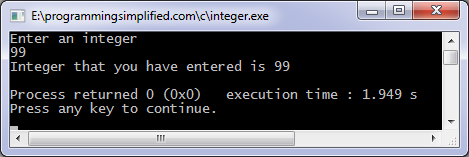
Output of program:
input number
In c language we have data type for different types of data, for integer data it is int, for character date char, for floating point data it's float and so on.

c program to check odd or even

C program to check odd or even using modulus operator

#include<stdio.h>
 
main()
{
   int n;
 
   printf("Enter an integer\n");
   scanf("%d",&n);
 
   if ( n%2 == 0 )
      printf("Even\n");
   else
      printf("Odd\n");
 
   return 0;
}
We can use bitwise AND (&) operator to check odd or even, as an example consider binary of 7 (0111) when we perform 7 & 1 the result will be one and you may observe that the least significant bit of every odd number is 1, so ( odd_number & 1 ) will be one always and also ( even_number & 1 ) is zero.

C program to check odd or even using bitwise operator

#include<stdio.h>
 
main()
{
   int n;
 
   printf("Enter an integer\n");
   scanf("%d",&n);
 
   if ( n & 1 == 1 )
      printf("Odd\n");
   else
      printf("Even\n");
 
   return 0;
}

Find odd or even using conditional operator

#include<stdio.h>
 
main()
{
   int n;
 
   printf("Input an integer\n");
   scanf("%d",&n);
 
   n%2 == 0 ? printf("Even\n") : printf("Odd\n");
 
   return 0;
}

C program to check odd or even without using bitwise or modulus operator

#include<stdio.h>
 
main()
{
   int n;
 
   printf("Enter an integer\n");
   scanf("%d",&n);
 
   if ( (n/2)*2 == n )
      printf("Even\n");
   else
      printf("Odd\n");
 
   return 0;
}
In c programming language when we divide two integers we get an integer result, For example the result of 7/3 will be 2.So we can take advantage of this and may use it to find whether the number is odd or even. Consider an integer n we can first divide by 2 and then multiply it by 2 if the result is the original number then the number is even otherwise the number is odd. For example 11/2 = 5, 5*2 = 10 ( which is not equal to eleven), now consider 12/2 = 6 and 6 *2 = 12 ( same as original number). These are some logic which may help you in finding if a number is odd or not.

C program to perform addition, subtraction, multiplication and division

C programming code

#include <stdio.h>
 
int main()
{
   int first, second, add, subtract, multiply;
   float divide;
 
   printf("Enter two integers\n");
   scanf("%d%d", &first, &second);
 
   add        = first + second;
   subtract = first - second;
   multiply = first * second;
   divide     = first / (float)second;   //typecasting
 
   printf("Sum = %d\n",add);
   printf("Difference = %d\n",subtract);
   printf("Multiplication = %d\n",multiply);
   printf("Division = %.2f\n",divide);
 
   return 0;
}
Download Arithmetic operations program.
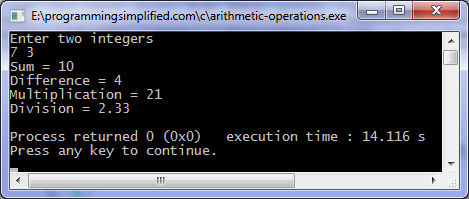
Output of program:
arithmetic operations program
In c language when we divide two integers we get integer result for example 5/2 evaluates to 2. As a general rule integer/integer = integer and float/integer = float or integer/float = float. So we convert denominator to float in our program, you may also write float in numerator. This explicit conversion is known as typecasting.

C program to check whether input alphabet is a vowel or not

C programming code

#include <stdio.h>
 
int main()
{
  char ch;
 
  printf("Enter a character\n");
  scanf("%c", &ch);
 
  if (ch == 'a' || ch == 'A' || ch == 'e' || ch == 'E' || ch == 'i' || ch == 'I' || ch =='o' || ch=='O' || ch == 'u' || ch == 'U')
    printf("%c is a vowel.\n", ch);
  else
    printf("%c is not a vowel.\n", ch);
 
  return 0;
}
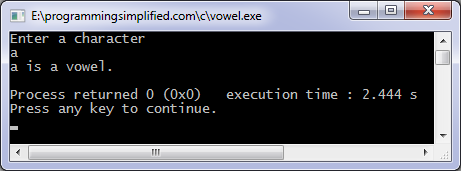
Output of program:
check vowel

Check vowel using switch statement

#include <stdio.h>
 
int main()
{
  char ch;
 
  printf("Input a character\n");
  scanf("%c", &ch);
 
  switch(ch)
  {
    case 'a':
    case 'A':
    case 'e':
    case 'E':
    case 'i':
    case 'I':
    case 'o':
    case 'O':
    case 'u':
    case 'U':
      printf("%c is a vowel.\n", ch);
      break;
    default:
      printf("%c is not a vowel.\n", ch);
  }              
 
  return 0;
}

Function to check vowel

int check_vowel(char a)
{
    if (a >= 'A' && a <= 'Z')
       a = a + 'a' - 'A';   /* Converting to lower case or use a = a + 32 */
 
    if (a == 'a' || a == 'e' || a == 'i' || a == 'o' || a == 'u')
       return 1;
 
    return 0;
}
This function can also be used to check if a character is a consonant or not, if it's not a vowel then it will be a consonant, but make sure that the character is an alphabet not a special character.

C program to check leap year

C programming code

#include <stdio.h>
 
int main()
{
  int year;
 
  printf("Enter a year to check if it is a leap year\n");
  scanf("%d", &year);
 
  if ( year%400 == 0)
    printf("%d is a leap year.\n", year);
  else if ( year%100 == 0)
    printf("%d is not a leap year.\n", year);
  else if ( year%4 == 0 )
    printf("%d is a leap year.\n", year);
  else
    printf("%d is not a leap year.\n", year);  
 
  return 0;
}
Download Leap year program.
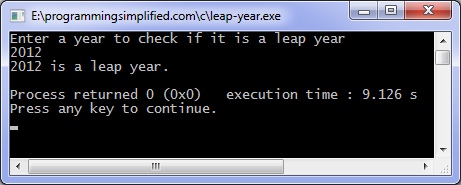
Output of program:
leap year program
Please read the leap year article at Wikipedia, it will help you to understand the program. This code is based on Gregorian Calendar.

Add digits of number in c

C programming code

#include <stdio.h>
 
int main()
{
   int n, sum = 0, remainder;
 
   printf("Enter an integer\n");
   scanf("%d",&n);
 
   while(n != 0)
   {
      remainder = n % 10;
      sum = sum + remainder;
      n = n / 10;
   }
 
   printf("Sum of digits of entered number = %d\n",sum);
 
   return 0;
}
For example if the input is 98, sum(variable) is 0 initially
98%10 = 8 (% is modulus operator which gives us remainder when 98 is divided by 10).
sum = sum + remainder
so sum = 8 now.
98/10 = 9 because in c whenever we divide integer by another integer we get an integer.
9%10 = 9
sum = 8(previous value) + 9
sum = 17
9/10 = 0.
So finally n = 0, loop ends we get the required sum.
Download Add digits program.
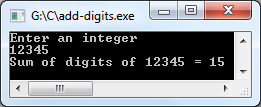
Output of program:
digit program output

Add digits using recursion

#include <stdio.h>
 
int add_digits(int);
 
int main() 
{
  int n, result;
 
  scanf("%d", &n);
 
  result = add_digits(n);
 
  printf("%d\n", result);
 
  return 0;
}
 
int add_digits(int n) {
  static int sum = 0;
 
  if (n == 0) {
    return 0;
  }
 
  sum = n%10 + add_digits(n/10);
 
  return sum;
}
Static variable sum is used and is initialized to 0, it' value will persists after function calls i.e. it is initialized only once when a first call to function is made.

Factorial program in c


Factorial program in c: c code to find and print factorial of a number, three methods are given, first one uses for loop, second uses a function to find factorial and third using recursion. Factorial is represented using '!', so five factorial will be written as (5!), n factorial as (n!). Also
n! = n*(n-1)*(n-2)*(n-3)...3.2.1 and zero factorial is defined as one i.e. 0! = 1.

Factorial program in c using for loop

Here we find factorial using for loop.
#include <stdio.h>
 
int main()
{
  int c, n, fact = 1;
 
  printf("Enter a number to calculate it's factorial\n");
  scanf("%d", &n);
 
  for (c = 1; c <= n; c++)
    fact = fact * c;
 
  printf("Factorial of %d = %d\n", n, fact);
 
  return 0;
}
Download Factorial program.
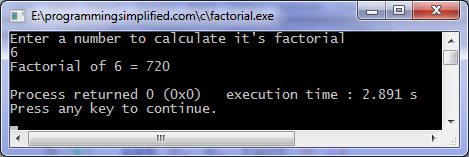
Output of code:
factorial code output

Factorial program in c using function

#include <stdio.h>
 
long factorial(int);
 
int main()
{
  int number;
  long fact = 1;
 
  printf("Enter a number to calculate it's factorial\n");
  scanf("%d", &number);
 
  printf("%d! = %ld\n", number, factorial(number));
 
  return 0;
}
 
long factorial(int n)
{
  int c;
  long result = 1;
 
  for (c = 1; c <= n; c++)
    result = result * c;
 
  return result;
}

Factorial program in c using recursion

#include<stdio.h>
 
long factorial(int);
 
int main()
{
  int n;
  long f;
 
  printf("Enter an integer to find factorial\n");
  scanf("%d", &n); 
 
  if (n < 0)
    printf("Negative integers are not allowed.\n");
  else
  {
    f = factorial(n);
    printf("%d! = %ld\n", n, f);
  }
 
  return 0;
}
 
long factorial(int n)
{
  if (n == 0)
    return 1;
  else
    return(n * factorial(n-1));
}
Recursion is a technique in which a function calls itself, for example in above code factorial function is calling itself. To solve a problem using recursion you must first express its solution in recursive form.

C program to find hcf and lcm

C programming code

#include <stdio.h>
 
int main() {
  int a, b, x, y, t, gcd, lcm;
 
  printf("Enter two integers\n");
  scanf("%d%d", &x, &y);
 
  a = x;
  b = y;
 
  while (b != 0) {
    t = b;
    b = a % b;
    a = t;
  }
 
  gcd = a;
  lcm = (x*y)/gcd;
 
  printf("Greatest common divisor of %d and %d = %d\n", x, y, gcd);
  printf("Least common multiple of %d and %d = %d\n", x, y, lcm);
 
  return 0;
}
Download HCF and LCM program.
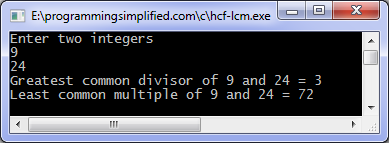
Output of program:
HCF and LCM c program

C program to find hcf and lcm using recursion

#include <stdio.h>
 
long gcd(long, long);
 
int main() {
  long x, y, hcf, lcm;
 
  printf("Enter two integers\n");
  scanf("%ld%ld", &x, &y);
 
  hcf = gcd(x, y);
  lcm = (x*y)/hcf;
 
  printf("Greatest common divisor of %ld and %ld = %ld\n", x, y, hcf);
  printf("Least common multiple of %ld and %ld = %ld\n", x, y, lcm);
 
  return 0;
}
 
long gcd(long a, long b) {
  if (b == 0) {
    return a;
  }
  else {
    return gcd(b, a % b);
  }
}

C program to find hcf and lcm using function

#include <stdio.h>
 
long gcd(long, long);
 
int main() {
  long x, y, hcf, lcm;
 
  printf("Enter two integers\n");
  scanf("%ld%ld", &x, &y);
 
  hcf = gcd(x, y);
  lcm = (x*y)/hcf;
 
  printf("Greatest common divisor of %ld and %ld = %ld\n", x, y, hcf);
  printf("Least common multiple of %ld and %ld = %ld\n", x, y, lcm);
 
  return 0;
}
 
long gcd(long x, long y) {
  if (x == 0) {
    return y;
  }
 
  while (y != 0) {
    if (x > y) {
      x = x - y;
    }
    else {
      y = y - x;
    }
  }
 
  return x;
}

Decimal to binary conversion

C programming code

#include <stdio.h>
 
int main()
{
  int n, c, k;
 
  printf("Enter an integer in decimal number system\n");
  scanf("%d", &n);
 
  printf("%d in binary number system is:\n", n);
 
  for (c = 31; c >= 0; c--)
  {
    k = n >> c;
 
    if (k & 1)
      printf("1");
    else
      printf("0");
  }
 
  printf("\n");
 
  return 0;
}
Download Decimal binary program.
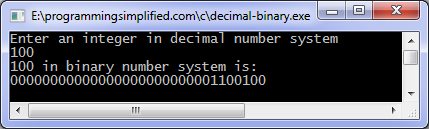
Output of program:
Decimal to binary c program
Above code only prints binary of integer, but we may wish to perform operations on binary so in the code below we are storing the binary in a string. We create a function which returns a pointer to string which is the binary of the number passed as argument to the function.

C code to store decimal to binary conversion in a string

#include <stdio.h>
#include <stdlib.h>
 
char *decimal_to_binary(int);
 
main()
{
   int n, c, k;
   char *pointer;
 
   printf("Enter an integer in decimal number system\n");
   scanf("%d",&n);
 
   pointer = decimal_to_binary(n);
   printf("Binary string of %d is: %s\n", n, t);
 
   free(pointer);
 
   return 0;
}
 
char *decimal_to_binary(int n)
{
   int c, d, count;
   char *pointer;
 
   count = 0;
   pointer = (char*)malloc(32+1);
 
   if ( pointer == NULL )
      exit(EXIT_FAILURE);
 
   for ( c = 31 ; c >= 0 ; c-- )
   {
      d = n >> c;
 
      if ( d & 1 )
         *(pointer+count) = 1 + '0';
      else
         *(pointer+count) = 0 + '0';
 
      count++;
   }
   *(pointer+count) = '\0';
 
   return  pointer;
}
Memory is allocated dynamically because we can't return a pointer to a local variable (character array in this case). If we return a pointer to local variable then program may crash or we get incorrect result.

C program to find ncr and npr

C program to find nCr using function

#include<stdio.h>
 
long factorial(int);
long find_ncr(int, int);
long find_npr(int, int);
 
main()
{
   int n, r;
   long ncr, npr;
 
   printf("Enter the value of n and r\n");
   scanf("%d%d",&n,&r);
 
   ncr = find_ncr(n, r);
   npr = find_npr(n, r);
 
   printf("%dC%d = %ld\n", n, r, ncr);
   printf("%dP%d = %ld\n", n, r, npr);
 
   return 0;
}
 
long find_ncr(int n, int r)
{
   long result;
 
   result = factorial(n)/(factorial(r)*factorial(n-r));
 
   return result;
}
 
long find_npr(int n, int r)
{
   long result;
 
   result = factorial(n)/factorial(n-r);
 
   return result;
} 
 
long factorial(int n)
{
   int c;
   long result = 1;
 
   for( c = 1 ; c <= n ; c++ )
      result = result*c;
 
   return ( result );
}
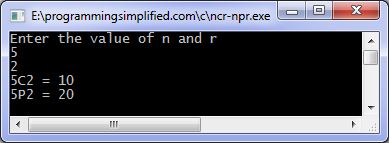
Download NCR and NPR program.
Output of program:
NCR and NPR c program

C program to add n numbers

C programming code

#include <stdio.h>
 
int main()
{
   int n, sum = 0, c, value;
 
   printf("Enter the number of integers you want to add\n");
   scanf("%d", &n);
 
   printf("Enter %d integers\n",n);
 
   for (c = 1; c <= n; c++)
   {
      scanf("%d",&value);
      sum = sum + value;
   }
 
   printf("Sum of entered integers = %d\n",sum);
 
   return 0;
}
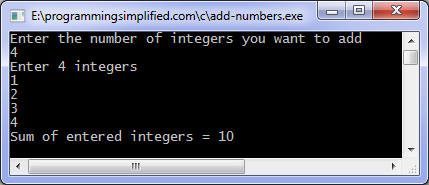
Download Add n numbers program.
Output of program:
Add n numbers c program

C programming code using array

#include <stdio.h>
 
int main()
{
   int n, sum = 0, c, array[100];
 
   scanf("%d", &n);
 
   for (c = 0; c < n; c++)
   {
      scanf("%d", &array[c]);
      sum = sum + array[c];
   }
 
   printf("Sum = %d\n",sum);
 
   return 0;
}